Why Is JavaScript Called JavaScript? The Story Behind the Name

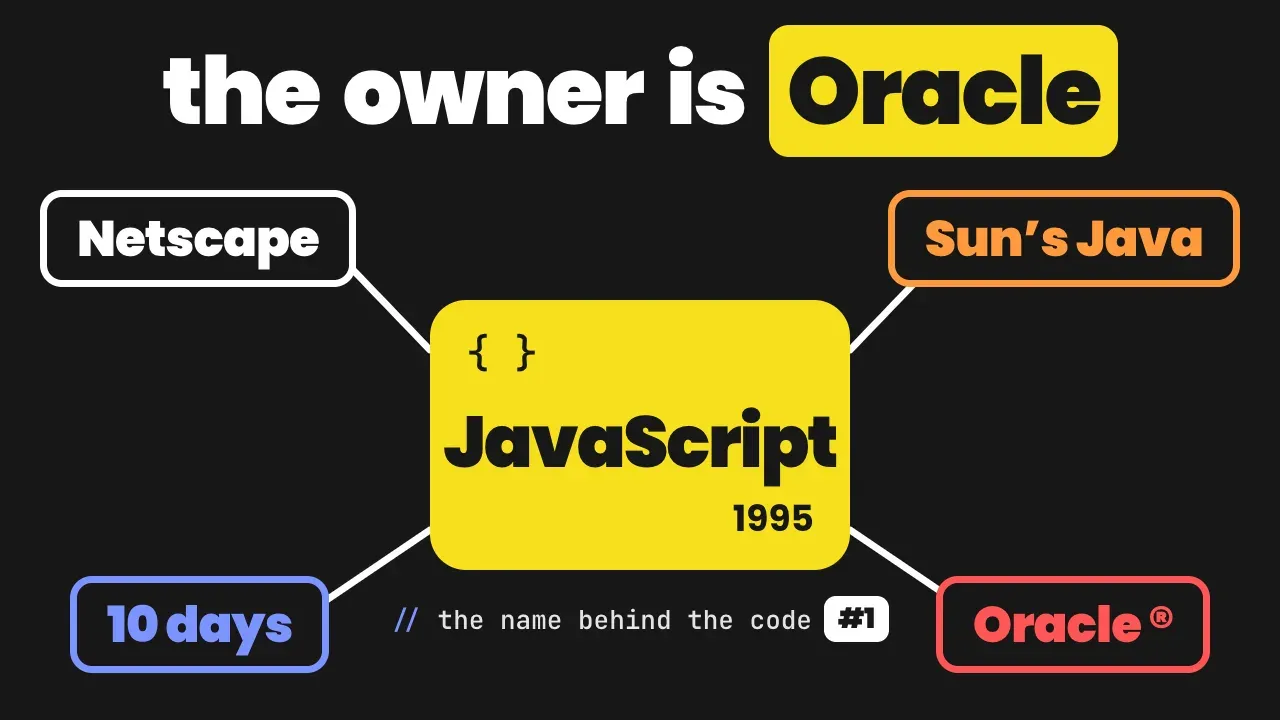
JavaScript is not Java, it is not a version of Java, and it was not made by the company behind Java. Still, almost every beginner trips over the same question: if the two languages are unrelated, why are the names so close?
The answer involves a fight between browsers, a prototype written in a rush in 1995, and a trademark that is still caught up in a legal case more than 30 years later. If you'd rather watch, the video above tells this story in four minutes. It's in Portuguese, with captions. This article goes deeper, with dates, comparisons and sources.
Why did Netscape need a language for the browser?
In 1995, Netscape Navigator was the most used browser on the internet, and Microsoft was arriving with Internet Explorer. This period is known as the browser wars. To stay ahead, Netscape wanted pages that reacted to what people did instead of just showing text and images.
That called for a scripting language: a simple language for small programs that run inside the page itself. Netscape hired Brendan Eich to embed Scheme, a language with academic roots, in the browser. Then management changed the request: the new language had to look like Java, which was everywhere at the time. And the deadline was extremely short.
How long did Brendan Eich take to create JavaScript?
The first version took about 10 days, in May 1995. The prototype was called Mocha and was meant to be an internal demo only.
One caveat matters here. The 10 days apply to the prototype, not to the language as we know it. It kept being reshaped over the following months and kept evolving for decades. Still, the rush of those first days explains several oddities that survive today.
Why does typeof null return "object"?
The most famous example of those leftovers is in any browser console:
typeof null; // "object"
null is not an object. That result is a bug from the first implementation, tied to the type tag the language used to identify objects. It was never fixed because fixing it now would break existing code that relies on it. A fix was proposed and rejected for exactly that reason.
From Mocha to LiveScript to JavaScript: how the name changed twice
In September 1995, the language shipped in a beta of Navigator 2.0 under a different name, LiveScript. At that moment Sun Microsystems' Java was the most talked-about language in the world, and Netscape had just struck a partnership with Sun.
In December 1995, the two companies announced together that LiveScript would be renamed JavaScript. Brendan Eich himself described the change as a marketing move by Netscape to ride Java's fame. It worked, and the name stuck. It also created a confusion that lasts to this day.
Are Java and JavaScript the same thing?
No. Looking at the code, the two look like cousins: curly braces, semicolons, if and for. Under the hood they are very different.
| Java | JavaScript | |
|---|---|---|
| Execution | Compiled, runs on a virtual machine (the JVM) | Born to run inside the browser |
| Types | You declare the type of each variable | The type is decided on the fly, at runtime |
| Inheritance | Class-based | Prototype-based |
int age = 30; // Java: the type is required
let age = 30; // JavaScript: the type comes from the value
The relationship is the same as between "ham" and "hamster": the words start the same and the resemblance ends there. The similar name became a problem for Netscape's competitors, and that pushed Microsoft into its next move.
What are JScript and ECMAScript?
When Microsoft wanted the same language in Internet Explorer, it could not use the name JavaScript, because the trademark belonged to Sun. In 1996 it shipped its own version in Internet Explorer 3, called JScript, with differences from Netscape's. Two different versions of the same language were a recipe for broken websites.
To fix that, Netscape took the language to Ecma, a standards organization, in November 1996. The first edition of the standard, ECMA-262, came out in June 1997 under a name nobody liked: ECMAScript. The name was a political compromise between the companies involved. Brendan Eich once said, in a Mozilla Bugzilla comment, that it sounded like a skin disease.
That is where the "ES" in ES6 comes from: ES6 is ECMAScript 2015, published in June 2015. Since then the standard has had one edition per year. The standard solved the technical confusion, but not the trademark question.
Who owns the name JavaScript today?
The "JavaScript" trademark was registered by Sun. When Oracle bought Sun, in January 2010, it inherited the registration. Oracle does not sell any product called JavaScript.
In September 2024, an open letter led by Ryan Dahl, creator of Node.js and Deno, asked Oracle to release the name. It passed 14,000 signatures, including Brendan Eich's. Oracle refused, and in November 2024 Deno asked the USPTO, the US trademark office, to cancel the registration.
Here is how the case has moved:
- In June 2025, the Trademark Trial and Appeal Board (TTAB) dismissed Deno's fraud claim. The arguments that the name is generic and that the mark was abandoned remained.
- In August 2025, Oracle filed its answer, denying those arguments.
- Throughout 2026, the parties kept requesting deadline extensions.
- On August 28, 2026, the case was suspended at Oracle's request, with Deno's consent, while the two sides negotiate a settlement.
Status checked on November 5, 2026: in the public TTAB record (proceeding 92086835), the case is still suspended pending settlement negotiations, with no final decision. This text will go out of date if that changes, so check the link in the sources.
In short
JavaScript is called JavaScript because of marketing. In December 1995, Netscape renamed LiveScript to ride the success of Java, in a partnership with Sun. The languages are different under the hood, and the borrowed name was never given back: today the trademark belongs to Oracle, which inherited it from Sun, and the future of the name sits in a case suspended for settlement talks.
This article is part of the series "O nome por trás do código" (The Name Behind the Code), on the YouTube channel. You can find it on the playlist.
Sources
- JavaScript (Wikipedia, History section)
- Browser wars (Wikipedia)
- Did Brendan Eich really make JavaScript in 10 days? (Hillel Wayne)
- typeof null: investigating a classic JavaScript bug (alexanderell.is)
- Brendan Eich's comment on the ECMAScript name (Mozilla Bugzilla, 2006)
- Sun acquisition by Oracle (Wikipedia)
- Help us raise $200k to free the JavaScript trademark (Deno, 2024)
- Deno v Oracle Update 3 (Deno, 2025)
- JavaScript Trademark Update (Deno, June 2025)
- Oracle maintains hold on JavaScript trademark (InfoWorld, 2025)
- Cancellation 92086835, Deno Land Inc. v. Oracle America, Inc. (TTABVUE, USPTO), accessed November 5, 2026