Why Is Linux Called Linux? The Story of Freax, Unix and GNU

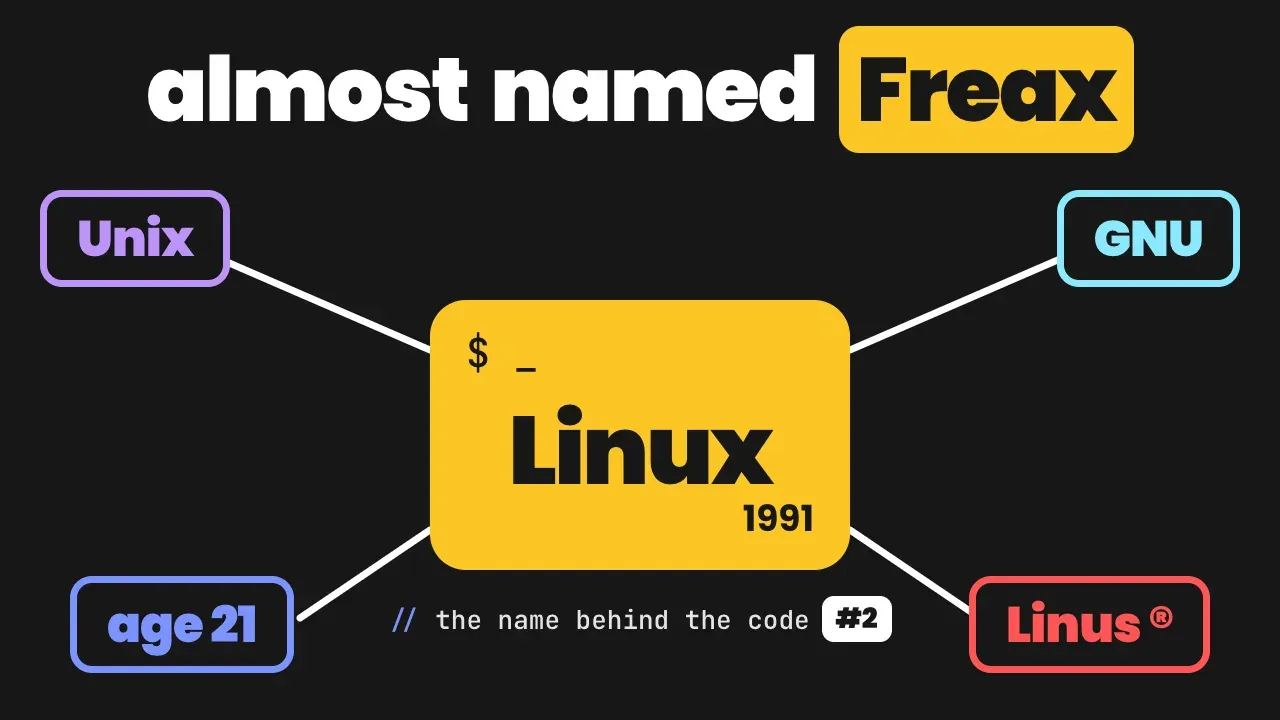
Linux runs your Android phone, sits behind most websites and powers the fastest supercomputers in the world. Yet its creator didn't want that name. Linus Torvalds thought "Linux" was too self-centered and picked another one: Freax.
So how did the name Linux end up on the project? The answer involves a 1960s operating system, an annoyed professor, a volunteer who created a folder on a server in Finland and a trademark fight.
Where does the "x" in Linux come from?
The "x" comes from Unix, an operating system created in 1969 at Bell Labs (AT&T) by Ken Thompson, Dennis Ritchie and colleagues, according to the history of Unix. An operating system is the program that makes a computer work, like Windows. The name Unix, originally "Unics", was a pun on Multics, a large and complicated system Bell Labs had walked away from.
Unix was a hit, but AT&T licensed the code, the licenses got expensive and nobody could freely redistribute it. In the video I compare it to a rented car: expensive, with the hood locked. The "x" became a kind of family name for systems inspired by it, such as Minix and Linux.
What is GNU and why didn't it have a kernel?
On September 27, 1983, Richard Stallman announced the GNU project, aiming to build a free system that anyone could open, study and modify. The name is a joke: GNU stands for "GNU's Not Unix", an acronym that contains itself.
By 1991 GNU had almost everything a complete system needs: the GCC compiler (1987), which turns code into programs, the Emacs editor and the Bash shell (1989). What it lacked was a kernel, the core that talks to the computer's parts (memory, disk, keyboard). GNU's kernel, Hurd, wasn't ready. In the car metaphor, GNU had built nearly the whole car, but the engine was missing.
Who created Linux and why?
The engine came from an unexpected place. In January 1991, Linus Torvalds, a 21-year-old student at the University of Helsinki, bought a PC with a 386 processor. He ran Minix, a system professor Andrew Tanenbaum had created in 1987 for teaching, whose license restricted redistribution.
Frustrated by those limits, Linus started writing his own kernel just for fun. On August 25, 1991, he told the comp.os.minix newsgroup that he was making a free operating system, and that it was just a hobby, not going to be big and professional like GNU. One thing was missing before he could publish the code: a name.
Why was Linux almost called Freax?
The name Linus wanted was Freax, a mix of "free", "freak" and the "x" from Unix. He had thought about "Linux", but found it too presumptuous, since it carried his own first name.
In September 1991 he uploaded the code to ftp.funet.fi (the story is on Linuxiac), the server where Finnish universities kept programs for download. Ari Lemmke, one of the server's volunteer administrators, didn't like "Freax" and created the folder under a different name: linux. Version 0.01 was published there on September 17, 1991. Linus didn't fight it, and the name stuck.
Freax didn't vanish completely. It survives in a comment in the kernel's Makefile from that first version:
# Makefile for the FREAX-kernel.
I checked that line on November 5, 2026, against a copy of version 0.01. Linus also recorded an audio clip explaining how he pronounces the name (roughly "LIN-ux", with a short "i"), which circulated with the code.
What was the Tanenbaum–Torvalds debate?
The first public fight came along with the name (the Tanenbaum–Torvalds debate). In January 1992, the professor who created Minix posted a message titled "LINUX is obsolete". His technical argument was that a modern kernel should be a microkernel, an engine made of separate parts, while Linux's was monolithic, a single block. Tanenbaum even joked that Linus wouldn't get a high grade if he were his student.
While that argument went on, Linux changed license. Starting with version 0.12, in 1992, it adopted the GPL, the GNU license that lets anyone use, change and share the code. Before that, its own license forbade commercial use. With the GPL, Linus's kernel fit into the GNU system, and the car finally ran.
Linux or GNU/Linux?
Because the system people actually use is the kernel plus the GNU tools, the Free Software Foundation and Richard Stallman still ask that the complete system be called GNU/Linux. Most people just say Linux, which strictly names the kernel. Both forms show up in books and distributions.
Who owns the Linux trademark?
The most dangerous fight over the name came from outside. In 1995, an American named William R. Della Croce Jr. registered "Linux" as a trademark in the United States without having written a line of the code, and began demanding 10% royalties from people selling Linux on CDs. The community and several companies went to court, and in 1997 the trademark was transferred to Linus Torvalds.
I checked on November 5, 2026: according to the Linux Foundation, Linus is still the worldwide owner of the mark, and the foundation is the exclusive licensee that handles sublicensing. The name he thought was too presumptuous is his, by law.
Unix is a registered trademark too, held by The Open Group, which runs its own certification. Almost no Linux distribution carries the badge, though there are exceptions, such as Huawei's EulerOS.
What came after Linux?
Fourteen years after Linux, in April 2005, Linus created another tool and this time picked the name himself: Git. The story behind that name is the next episode of the series.
In short
Linux has that name because the person who ran the server where it was first published didn't like Freax and created a folder called linux. Linus Torvalds found the name too presumptuous, but it stuck, and the "x" tied the system to the Unix family. The name later survived an attempt by an outsider to register it and returned to Linus in 1997. Today he owns the trademark, and the Linux Foundation looks after it.
This article is part of the series The name behind the code on the Código ao Ponto channel, in Portuguese.
Sources
- History of Unix (Wikipedia)
- Initial announcement of the GNU project (gnu.org, 1983)
- Linux and the GNU System and GNU/Linux FAQ (gnu.org)
- History of Linux (Wikipedia)
- Minix (Wikipedia)
- Tanenbaum–Torvalds debate (Wikipedia)
- Linux's real birthday (Linuxiac), with the Makefile comment
- Linux, Trademark section (Wikipedia)
- The Linux Mark (Linux Foundation, checked on 11/05/2026)
- Linus-linux.ogg (Wikimedia Commons)
- Git (Wikipedia)